Lecce – Capital of Baroque
Just an hour’s drive from Villa Gufo, you’ll find the stunning city of Lecce, a must-visit destination.
In the 19th century, the German historian Ferdinand Gregorovius visited Lecce and gave it the nickname “The Florence of the South.” But Lecce has even more nicknames! Due to its aristocratic, spiritual, and intellectual nature—rather than being an economic and commercial hub—the city is also known as “The Athens of Puglia.” The many Baroque palaces and churches have also earned it the title of “Capital of Baroque.”
Lecce has Greek origins and was inhabited by the Messapians in the 4th century BC, an ancient civilization of Southern Italy. When the Romans conquered the city in the 3rd century BC, they renamed it Lupiae and developed it into a thriving trade center. Some of the city’s most impressive ruins date back to this era, including the Roman Amphitheater and Roman Theater.
After the fall of the Roman Empire, Lecce came under various rulers, including the Byzantines, Normans, and Aragonese. However, it was in the 16th and 17th centuries that Lecce experienced its golden age, transforming into a Baroque masterpiece.
One of the reasons for Lecce’s extravagant Baroque style is its local soft limestone, “pietra leccese.” This unique stone allowed architects and sculptors to create incredibly detailed facades and decorations, shaping the ornate Baroque style that makes the city so special today.
This durable stone was ideal for intricate sculptures and architectural details, and it has been used throughout Lecce for: spiral columns, ornate cornices and balustrades, decorative pediments, vases and fruit baskets as embellishments
With its rich history, artistic beauty, and unique limestone architecture, Lecce is a city that enchants every visitor.
Piazza del Duomo – The Elegant Heart of Lecce
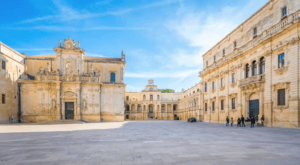
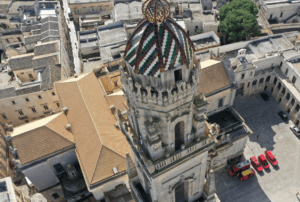
This magnificent square is considered one of the most elegant squares in Italy. The Cathedral of Lecce, dedicated to Maria Santissima Assunta, features an impressive two-tiered Baroque façade and a towering Campanile.
What makes Piazza del Duomo so unique is its enclosed character: the square is surrounded on three sides by monumental buildings—the Campanile, the cathedral (Duomo), the Episcopio, and the Seminario—and is accessible only through a narrow entrance, creating an intimate and awe-inspiring atmosphere.
- The Seminario (on your right) was inaugurated in 1709 by Bishop Michele Pignatelli. Today, this beautiful Baroque building houses the Diocesan Museum of Sacred Art.
- The Episcopio (directly in front of you, next to the cathedral entrance) was designed in the 17th century by Emanuele Manieri and served as the bishop’s residence. A remarkable feature is its large clock, crafted in 1764 by Domenico Panico. This was one of the first public clocks in Lecce and played an important role in the daily life of the city’s residents.
- The Campanile, standing nearly 70 meters tall, was built between 1661 and 1682 by Giuseppe Zimbalo, one of Lecce’s most renowned architects. The tower not only offers a breathtaking view over the city, but on clear days, you can even see the Adriatic Sea!
Tip: Visit the square at sunset, when the facades are beautifully illuminated.
Click HERE for the location of Piazza del Duomo
The Most Baroque Monument in Lecce: Basilica di Santa Croce
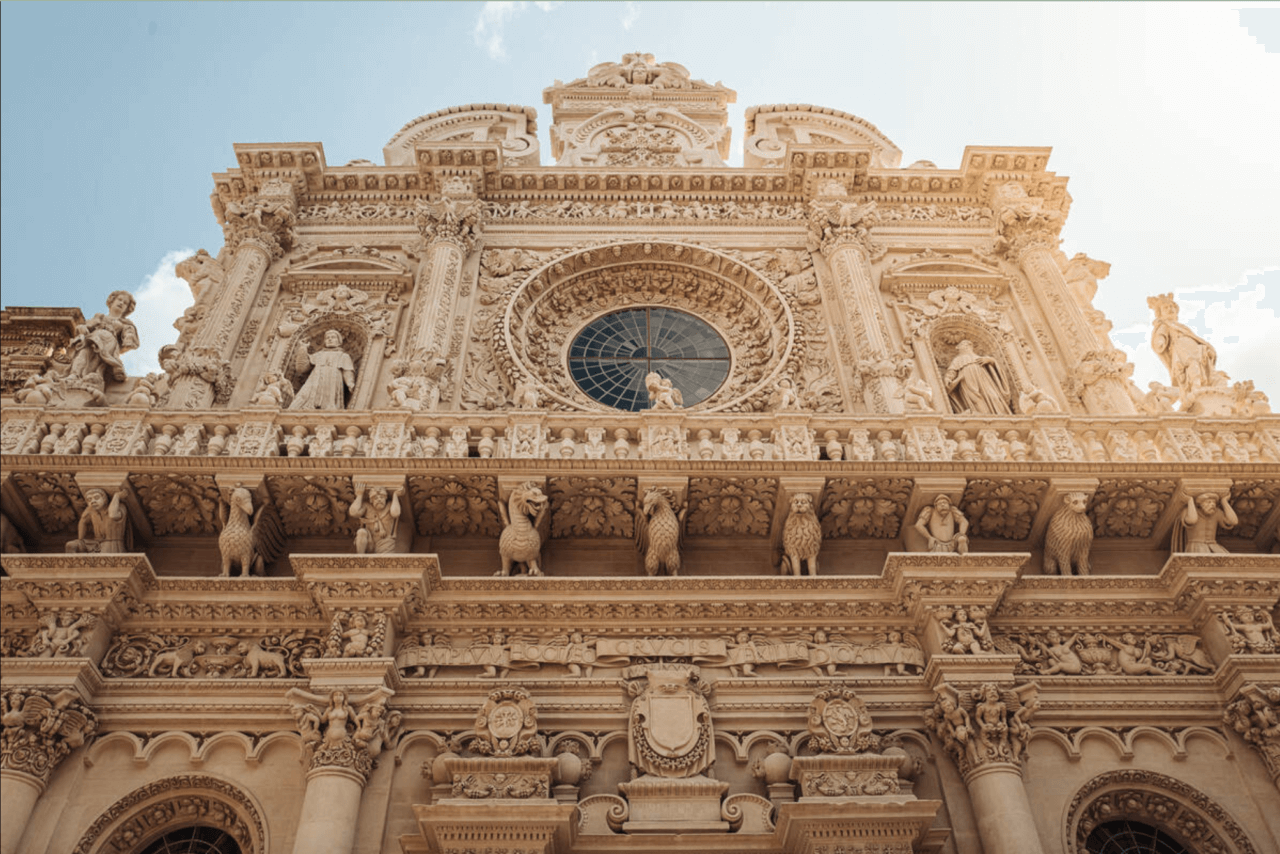
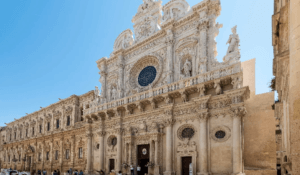
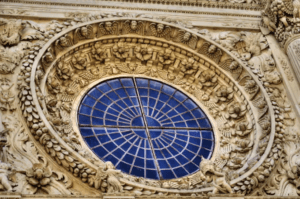
The most Baroque monument in Lecce is undoubtedly the Basilica di Santa Croce. Construction began in 1549 and was not completed until 1689. The façade of this church is so richly decorated that you don’t know where to start looking—each detail is more impressive than the last, and you’ll keep discovering something new every time.
Three architects were responsible for this Baroque masterpiece: Gabriele Riccardi, Cesare Penna, and Francesco Antonio Zimbalo. Together, they designed the decorative elements of the façade, creating an extravagant and diverse display of sculptures and ornaments. Among the intricate details, you’ll find anthropomorphic figures, animals, floral decorations, cherubs (putti), and grapevines—all carved with remarkable precision and artistry.
Click HERE for the location of Basilica di Santa Croce
Piazza Sant’Oronzo & The Roman Amphitheater
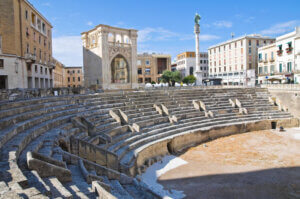
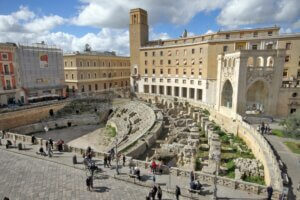
At Piazza Sant’Oronzo, the impressive Roman Amphitheater stands as one of Lecce’s most significant archaeological discoveries. Next to it, you’ll find the statue of Sant’Oronzo, the city’s patron saint, watching over Lecce from above. According to legend, Sant’Oronzo saved Lecce from the plague, and in gratitude, he was given this honored place in the city. However, the column on which his statue stands is much older. Originally, it was one of two columns that marked the end of the Via Appia in Brindisi, one of the most important trade routes of the Roman Empire.
The Roman Amphitheater, dating back to the 1st or 2nd century AD, was only discovered in the early 20th century during construction work. The structure is believed to have been built during the reign of Emperor Augustus or Emperor Trajan-Hadrian. At its peak, the amphitheater could hold up to 25,000 spectators, who gathered here to watch gladiator battles and wild animal hunts featuring lions and bears.
Today, only one-third of the amphitheater is visible, while the rest remains buried beneath nearby buildings, including the Chiesa di Santa Maria della Grazia. Despite this, it remains a cultural landmark, hosting performances and events throughout the year.
Excavations are still ongoing, and new historical artifacts continue to be uncovered, offering even deeper insights into Lecce’s fascinating past.
Click HERE for the location of Piazza Sant’Oronzo
Roman Theater
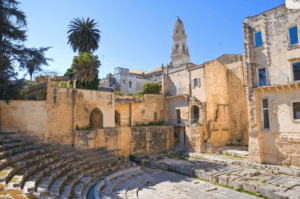
Not far from the amphitheater, you’ll find another remarkable ancient site: the Roman Theater (Teatro Romano). This theater was accidentally discovered in 1929 during construction work in the gardens of two historic buildings, Palazzo D’Arpe and Palazzo Romano. While the exact date of its construction remains uncertain, historians believe it dates back to the Augustan period, at the beginning of the 1st century AD.
The theater could accommodate an estimated 5,000 spectators and served as a stage for tragedies and comedies, highlighting the vibrant cultural life of ancient Lecce.
Click HERE for the location of the Roman Theatre
Delicacies from Lecce
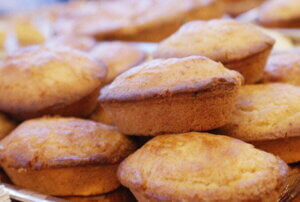
Pasticciotto is an iconic sweet pastry from Lecce and the Salento region. This delicious treat features a crispy, golden-brown shortcrust pastry (pasta frolla) filled with a creamy vanilla custard (or other flavors such as pistachio, chocolate, or cherry).
TIP: The pasticciotti from Pasticceria Luca Capilungo are in a class of their own. People travel from all over the region just to get their hands on these sweet delights. Luca bakes around 300 pasticciotti a day! You can also enjoy a variety of other pastries and drinks at the bar inside the bakery.
Click HERE for the location of Pasticceria Luca Capilungo
Website
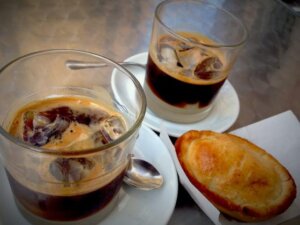
Caffè Leccese (also known as Caffè in ghiaccio con latte di mandorla) is Lecce’s ultimate summer coffee specialty. This refreshing drink consists of cold espresso with almond milk and ice cubes, the perfect way to cool down on a hot day.
The tradition of coffee with ice originally comes from Spain and was later adopted in Lecce and the Salento region. What makes Lecce’s version unique is the addition of sweet almond milk, creating a perfect balance between bitterness and sweetness.
Tip: Try Caffè Leccese at an authentic café in Lecce, such as Caffè Alvino on Piazza Sant’Oronzo!
Click HERE for the location of Caffè Alvino
Via Giuseppe Libertini
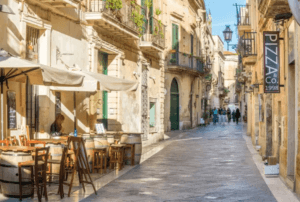
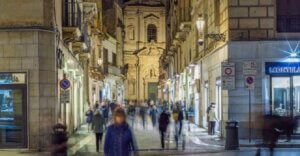
When you enter Lecce’s historic center through Porta Rudiae (see below under “Where to Park”), you will immediately find yourself on Via Giuseppe Libertini. This charming, picturesque street is not only highly photogenic, but it is also lined with lovely shops and excellent restaurants. As you walk along, you will also pass by several historical highlights of the city, making it a perfect route to explore Lecce’s rich heritage.
Ckick HERE for the location Via Giuseppe Libertini
Porta Rudiae
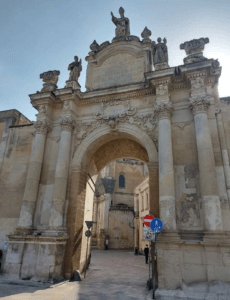
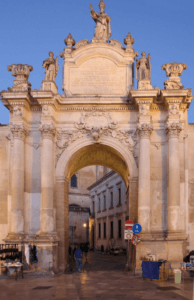
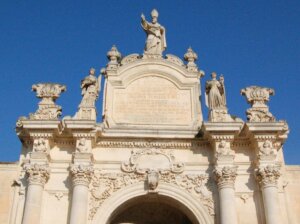
Porta Rudiae is the oldest and one of the most impressive city gates of Lecce, located on the western edge of the historic center. The gate is named after the ancient city of Rudiae, believed to be the birthplace of the poet Ennius, and once served as a main entrance to Lecce.
The structure consists of a single arch, flanked by two columns on either side, resting on a raised platform. Above the arch, a frieze displays busts of the city’s mythical founders: Malennio, Dauno, Euippa, and Idomeneo. At the top, the gate is crowned by a statue of Saint Orontius (Sant’Oronzo), the patron saint of Lecce, flanked by statues of Saint Irene and Saint Dominic.
Shopping in Lecce
Not far from the central Piazza Sant’Oronzo, you’ll find Piazza Mazzini, a square surrounded by shops and shopping streets. Here, you can browse both national and international brands.
- Street for Local Shops: Corso Vittorio Emanuele II
- Charming Street with Artisan Shops & Traditional Souvenirs: Via Palmieri
Note! Most shops are closed between 1:00 PM and 4:00 PM!
Where to Park?
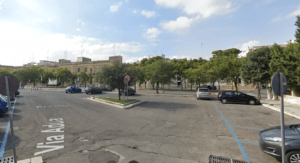
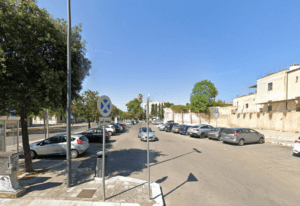
If you’re visiting Lecce’s historic center, this is the best place to park!
Note: This is a paid parking lot.
- Address: Viale dell’Università, 26, 73100 Lecce
- Click HERE for the parking location
From here, it’s just a 50-meter walk to the old city gate, Porta Rudiae. Entering through this gate, you’ll pass by all the major highlights of the historic city.